


Auto accident Orthopedic billing can cause revenue loss. Especially when claims take more documentation, more payer follow-up, and more payment review than standard commercial claims.
Orthopedic practices may deliver complex care for accident injuries, but still receive reduced, delayed, or unclear payments. This happens when the claim is not coded, documented, and monitored correctly.

This matters because Auto injury claims are not simple office visits.
They often involve personal injury protection, MedPay, liability coverage, attorneys, adjusters, case managers, and sometimes Work Comp overlap. Each layer adds one more chance for a payment to be reduced or delayed.
For Orthopedic groups, the risk is even higher
Auto accident care may include imaging review, fracture care, injections, post-surgical follow-up, durable medical equipment, therapy coordination, and detailed progress notes. The work is valuable, but the reimbursement process can be messy.
Orthopedic practices should not assume the payment is correct.
Simply because claims are processed does not mean they are processed correctly. Auto claims may be subject to network reductions, bill review adjustments, fee schedule interpretations, usual and customary reimbursement methodologies, or administrative errors. All of those can lower the final payment.
Because many Orthopedic procedures carry higher reimbursement values than routine office visits, even small percentage reductions can create significant revenue loss over time.
Reviewing
Explanation
of Benefits
Verifying
Payment
Calculations
Identifying unsupported reductions
Reviewing explanations of benefits, verifying payment calculations, and identifying unsupported reductions can help practices protect revenue that was rightfully earned.
There is a way for Orthopedic groups to protect Work Comp and Auto cases from PPO, network, and retroactive reductions. Practices that want to understand where payment is leaking often review how their industry counterparts leverage BOOST Health Tech to protect reimbursements.
Why Auto Reimbursements are harder to manage
Auto accident medical billing is different because the payer may not be the same type of payer your billing team works with every day. In a routine commercial claim, the practice usually knows the patient's plan, network status, deductible, and claim address.
In an Auto case, those details may change as more information becomes available.
The patient may have PIP benefits. They may have MedPay coverage. Another driver's liability carrier may become involved. An attorney may request records. A case manager may ask for updates. The practice may also need to track claim numbers, accident dates, policy limits, and state-specific rules.
The Texas Office of Public Insurance Counsel explains that PIP and MedPay can both pay regardless of fault, but they are different coverages. This distinction matters for providers because the billing path, documentation needs, and payment limits may differ by claim.
When these details are not verified early, the claim can move through the wrong workflow. A bill may be sent to the wrong carrier. A claim number may be missing. The provider may not know whether the patient has reached a policy limit. Even small intake errors can lead to a long payment delay.
For Orthopedic practices, time delays are expensive. Staff may spend weeks chasing information that should have been captured before the first bill went out. Meanwhile, the practice has already provided care, paid staff, used clinical resources, and carried the receivable.
In addition to payment delays, Orthopedic practices may also face payment reductions that are difficult to identify without careful review.
Auto claims can be affected by fee schedule interpretations, bill review adjustments, network reductions, usual and customary reimbursement methodologies, or policy limitations.
If the practice does not verify how the payment was calculated, it may accept less than expected reimbursement without realizing it. Over time, these reductions can have a meaningful impact on collections, particularly for higher-value orthopedic services such as fracture care, injections, imaging review, durable medical equipment, and post-surgical treatment.
Documentation Gaps can lower reimbursemenT
Personal injury Orthopedic reimbursement depends on a clear connection between the accident, the injury, the treatment plan, and the medical necessity of each service. If the note does not make that connection easy to see, the payer has an opening to question the claim.
That does not mean the care was wrong. It means the story may not be clear enough for the billing
process. Orthopedic documentation should show what happened, what body part was injured,
what objective findings support treatment, and why the service was needed at that point in
recovery.
For example, a patient may come in after a crash with shoulder pain. The claim is stronger when the record connects the mechanism of injury to the exam findings, imaging review, diagnosis, treatment plan, and follow-up needs. If those pieces are scattered or vague, the payer may treat the claim as less complete.
The Centers for Medicare & Medicaid Services publishes ICD-10-CM guidance that includes the role of external cause codes in capturing injury circumstances. While coding rules vary by setting and payer, the larger point is simple: injury claims need accurate detail. Missing details can make accident-related care harder to support.
This is one reason Orthopedic practices should not treat auto injury claims like standard commercial claims. The documentation burden is usually higher. The billing review is often stricter. The financial impact can be larger when a claim is reduced.
PAyer reviews can turn complex care into reduced payments
Auto injury claims Orthopedic surgery cases can be especially vulnerable to payer review. These cases may include higher charges, more follow-up visits, more coordination, and more documentation. That makes them important revenue opportunities, but also important audit targets.
Payers may review whether the service was related to the accident. They may question whether the treatment was necessary. They may apply a reimbursement benchmark. They may also look for a network discount, even when the practice expects a different payment amount.
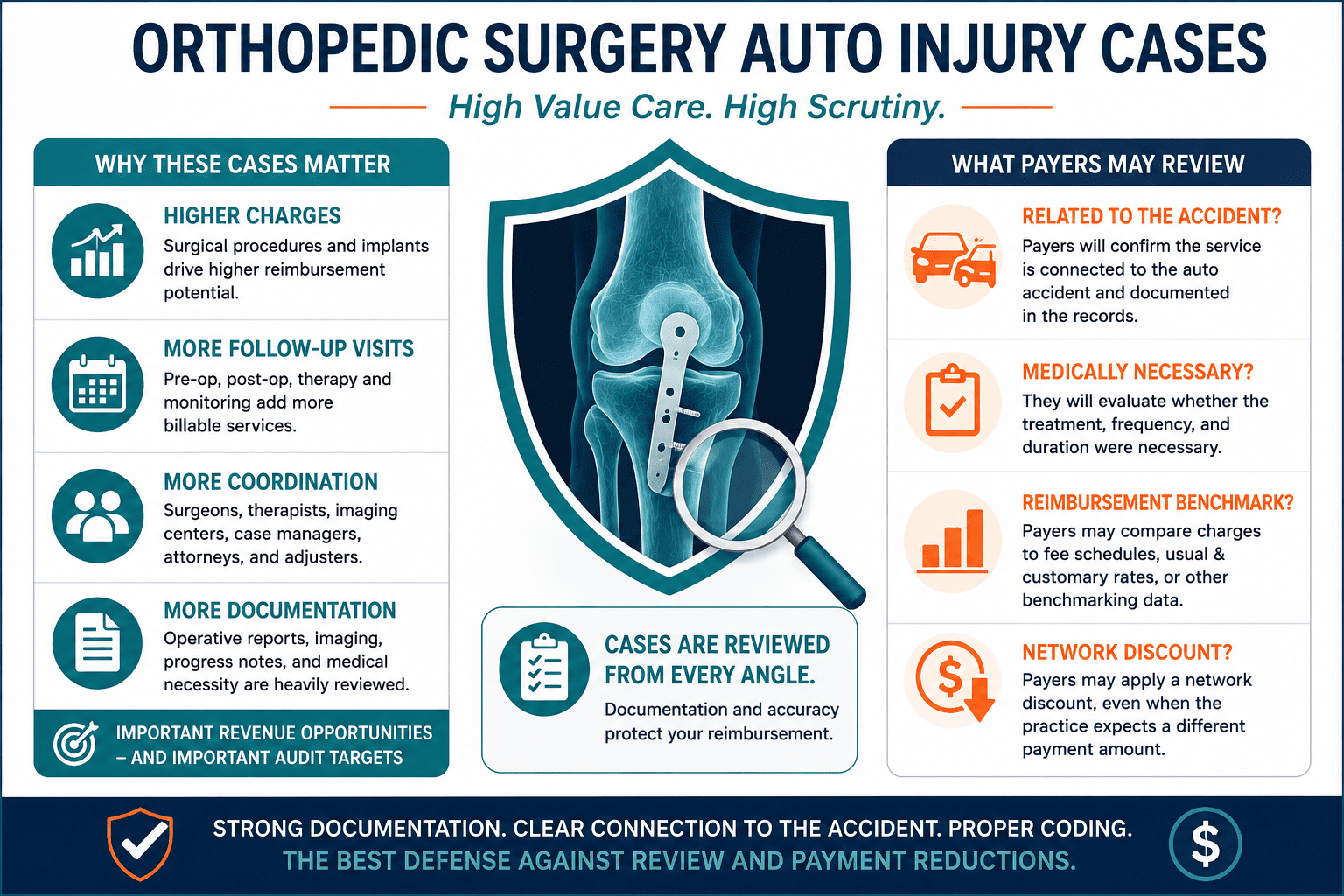
This is where revenue loss often hides. The practice sees a payment, but the payment is lower than expected. The explanation may be unclear. The reduction may look routine. If no one audits the payment against the expected reimbursement, the loss becomes easy to miss.
Auto accident Orthopedic billing also creates more room for payer confusion.
One claim may involve an initial evaluation, diagnostic work, surgical care, post-operative visits, therapy, and durable medical equipment. If these are not billed and tracked cleanly, different parts of the claim may be paid in different ways.
A lower payment on one line item may not look alarming by itself. But repeated reductions across many auto accident claims can reduce monthly revenue. This is why practices should look beyond total collections and review reimbursement per claim, per visit, and per payer.
The financial impact can be especially significant for Orthopedic practices.
Many auto accident claims involve higher-value services than routine office visits. Surgical procedures, fracture care, injections, imaging interpretation, durable medical equipment, and post-operative treatment can represent substantial reimbursement amounts.
When a reduction is applied to these services, even a small percentage adjustment can translate into meaningful lost revenue. Over time, multiple reductions across multiple claims can create a gap between the care provided and the reimbursement received.
CoMmon Mistakes that Lead to Auto Claim Revenue Loss
1. Many revenue problems start before the claim is submitted.
Intake teams may not capture the accident date, claim number, policy information, adjuster contact, attorney contact, and coverage type. Without those details, the billing team is forced to repair the claim later.
2. Another common mistake is assuming the first insurance card tells the full story.
A patient may show a health insurance card, but the visit may be related to an auto accident. If the practice does not identify the accident connection, the claim may be routed incorrectly.
3. A third mistake is failing to document causation.
Orthopedic providers do not need to write a legal argument. But they do need to make the medical connection clear. The note should explain why the patient's symptoms, exam findings, and treatment plan relate to the motor vehicle accident when that is clinically accurate.
4. A fourth mistake is accepting reductions without review.
The payer may issue an EOB with a discounted amount, a vague adjustment, or a repriced allowance. If the team posts the payment without checking the reason, the practice may lose money that could have been challenged.
This is where strong revenue cycle habits matter. BOOST's article on how physical therapy works with Work Comp explains the value of proper documentation, authorization, and submission. The same discipline can help Orthopedic practices manage auto cases with fewer surprises.
These mistakes rarely create a problem on just one claim. The greater risk is that they become part of the practice's normal workflow. A missing claim number, an undocumented accident connection, or an unexplained payment reduction may seem minor in isolation.
However, when the same issue occurs across dozens of auto injury cases, the result can be delayed cash flow, additional administrative work, and lower overall reimbursement. Identifying these patterns early can help practices correct revenue leaks before they become significant financial problems.
How Orthopedic Practices can protect auto accident revenue
The first step is to build a separate workflow for accident-related claims. These claims should not be handled exactly like routine commercial claims. They need their own intake checklist, billing checklist, and payment review process.
At intake, the team should confirm the accident date, claim number, payer type, adjuster details, attorney details, policy limits when available, and whether PIP or MedPay applies. This helps the practice avoid routing errors.
During care, providers should keep notes clear and direct. Shorter documentation is not always better. The goal is useful documentation. Each note should support the reason for treatment, the body part treated, the patient's functional limits, and the plan for next steps.
During billing, the team should check that codes, modifiers, diagnosis details, and claim details match the accident-related record. This helps reduce avoidable denials and payment questions.
After payment, every EOB should be reviewed. The team should ask: Was the expected rate paid? Was a PPO reduction applied? Was a network reduction used? Was the reason clear? Is the reduction valid? If the answer is unclear, the claim should be flagged.
Practices can also compare Auto claim performance against other high-value case types. BOOST's guidance on how much insurance companies pay for physical therapy is useful because it shows why reimbursement trends should be reviewed instead of assumed.
Leaders should also review their average reimbursement by payer and case type. A practice may look busy and still lose revenue if high-work claims are being reduced. BOOST's article on average profit margins for PT clinics makes the same point: profit depends on what you keep, not only how many patients you see.
why boost fits this problem
Auto accident Orthopedic billing requires more than claim submission. It requires protection from the reductions that can happen after the claim leaves your system. That is the gap many practices miss.
BOOST helps member clinic groups protect Work Comp and Auto claims from PPO, network, and retroactive reductions. The goal is not to make the practice add more patients or replace its current systems. The goal is to help the practice get paid more accurately for the claims it already has.
For orthopedic practices, this can be especially important when auto injury claims involve high-value services and complex care. If those claims are reduced without review, the practice may lose revenue on some of its most resource-heavy cases.
A better process starts with clean intake, clear documentation, accurate billing, and active payment review.
From there, practices can identify which reductions are valid and which ones should be challenged. BOOST Health Tech's client success examples show how protecting claims can create measurable reimbursement improvements.
Auto accident Orthopedic billing does not have to feel unpredictable. With the right workflow, practices can reduce confusion, protect reimbursement, and stop accepting unexplained reductions as normal.
About BOOST Health Care
Focusing exclusively on maximizing reimbursements from Work Comp and Auto claims, BOOST Health Tech was developed as an innovative service combined with a proprietary infrastructure. With the benefits of Third-Party Administrator (TPA) status, practices bypass the usual PPO, network, and retroactive reductions, leading to significantly higher reimbursements. No changes to treatment, EMR, billing systems, or additional administrative burdens. No need for software. Ortho groups just get the reassurance of stronger reimbursements.